
Social Cognitive Theory as a Proposed Model for Healthcare Provider Change
The Social Cognitive Theory posits behavioral change is influenced and motivated by a person’s environment, personal factors, and the characteristics or traits of the behavior itself (Kritsonis, 2005). Kritsonis states self-efficacy is the hallmark of this theory and must be present in order for behavioral change to occur; self-efficacy is the most important aspect of behavioral change (2005). Self-efficacy is evident when the individual believes in his or her capacity to not only perform a behavior, but that there will be beneficial outcome(s) from adopting the behavior; behavior results from perceived consequences, and the consequences must produced relatively immediate positive benefits such as higher levels of energy or evidence of disease prevention (Kritsonis, 2005).
Kritsonis proposes three methods to improve self-efficacy: provide very clear instructions; provide occasion to develop the new skill via training and education; and lastly, to model the desired behavior (2005). This concept can be expanded to produce successful organizational change by following four processes:
- Attentional process posits individuals learn from a model when they can relate to it, when it s packaged clearly and succinctly and it involves something they care about.
- Retention process accounts for the individual ability to remember and replicate a model and its characteristics.
- Motor reproduction process involves the individual converting what he or she “sees” into action- “seeing into doing”.
- Reinforcement processes involve rewarding individuals for changing behaviors.
(Kritsonis, 2005).
For a clinician to adopt behavior change, in this case a different view of assessing and intervening in hormone related anxiety and depression, the clinician must not only perceive he or she can adopt the change, but the change will produce immediate positive results for his or her patients; in this case successful alleviation of depression and anxiety symptoms in per- and post menopausal women. The perceived change intervention must also be evidence based and proven to be efficacious; safety is an important driver, as well as resources regarding the proposed practice change such as ongoing continuing education, access to peers utilizing the same therapies via private social networks and blog forums.
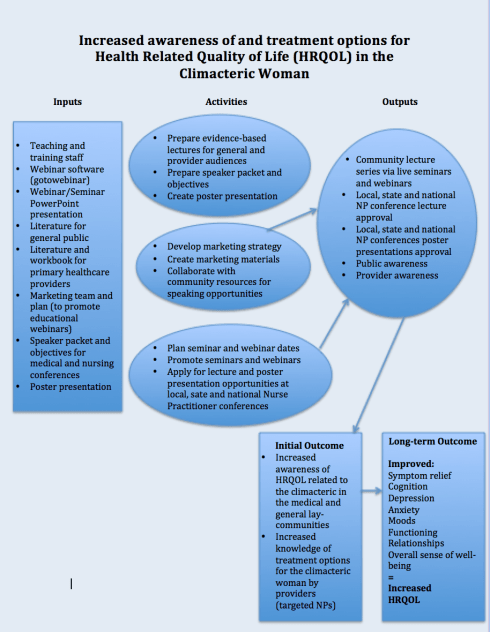
Logic Model
(Climacteric refers to the phase in the aging of women marking the transition from the
reproductive phase to the non-reproductive state, also known as peri-menopause).
 Androgen Hormone Therapy for Women